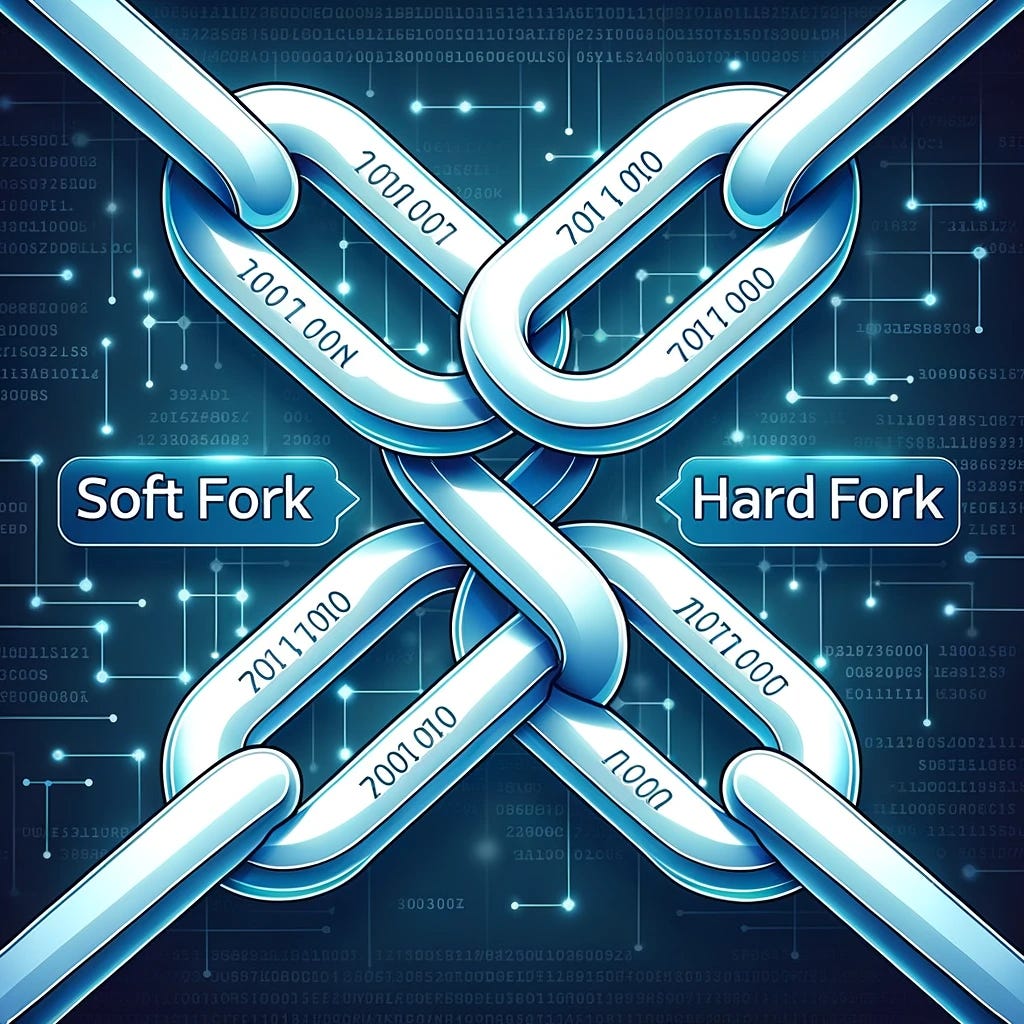
🔗 Blockchain: Understanding Soft Fork vs. Hard Fork

📖 The Basics of Forks
A "fork" in the blockchain world refers to a protocol upgrade. This change can be either a soft fork or a hard fork, depending on its compatibility with existing rules.
🌱 Soft Fork: A Gentle Diversion
Soft forks add features without altering the core rules. Nodes running old software still validate new transactions but might not recognize features of the updated version. An example is Bitcoin's SegWit, which enhances transaction efficiency without changing underlying rules.
➡️ Usage: Adds backward-compatible features and fixes security vulnerabilities in the blockchain protocol.
✅ Pros: seamless integration; not all nodes need to upgrade immediately, ensuring continuity. ❌ Cons: Can be perceived as less democratic, potential confusion for nodes not updated.
🔨 Hard Fork: A Definite Break
Hard forks introduce significant protocol changes. All nodes must upgrade to avoid being on a different chain. For example, the Bitcoin Cash hard fork increased the block size from 1MB to 8MB.
➡️ Usage: Introduces significant and breaking changes, such as new consensus algorithms, block sizes, or transaction formats.
✅ Pros: Clear-cut decision-making, gives every participant a voice.
❌ Cons: Higher risk, can lead to a potential permanent community split if nodes don't unanimously upgrade.
🤷♂️ Soft Fork or Hard Fork?
Soft forks tweak without disrupting, while hard forks introduce noticeable changes, giving participants a choice of chains. The former is subtler, while the latter can be divisive and might compromise security if the community is split.
💡 In conclusion, each has its advantages and challenges, and their impact on the network's future can be profound. Always stay informed and consider the long-term implications of any proposed changes.